At MartianCraft, we've done a lot of work over the past few years under what are called "no-publicity" clauses. That means we can't talk about those projects or put them in our portfolio. In fact, most of the really interesting work we did our first couple years was done that way. That was one of several reasons why, about a year ago, we chose to create a products division. By developing our own software, we're also filling out our portfolio with apps that we can show to prospective clients. Of course, that's not the only reason we decided to write our own software, but the fact that we couldn't talk about our most interesting projects was certainly a factor.
Getting Briefs out the door was a long slog, but it has been a great experience for us. The app has been well received and is being used regularly by an active and engaged community of users. Development has continued unabated since the 1.0 release, with new features being planned and actively developed.
Part of what made Brief's development so hard was keeping the very existence of the project under wraps until a few months before release. Spending nearly a year working on something we couldn't talk about really took its toll on our team.
But Briefs wasn't the only product idea we came up with last year. It's not even the only idea that we began to work on when we decided to create our own products.
We've had a second skunkworks project going from the time Briefs started, but on a much slower burn. For over a year, we've been working on ideas for a series of games. The project has been so secret that most of our staff at MartianCraft know little more about the project than the fact that it exists.
At first, there wasn't a lot of day-to-day work happening on this other project. It was mostly just Rob and me brainstorming ideas for what to do after Briefs. Then it morphed into something that Rob and I would talk about in the evenings, on the weekends or when we just needed a break.
And then it took on of a life of its own.
It turns out that we're both interested in games as a storytelling medium and we both wanted our next project to be a game, preferably one that provides an immersive, cinematic experience for the player. We also realized that we already have an awful lot of the talent in-house needed to create these kinds of games. While we've done a small amount of graphics and game work for clients over the years, we both wanted to create something that we controlled… something that was completely ours.
Over several months, we created a universe and populated it with dozens of characters. We explored the state of technology and the politics of the universe and mapped out a hundred years or so of history. We came up with ideas for several interconnected games set in the universe and wrote scripts for game cinematics. We also wrote scripts and stories that weren't tied to a specific game, but were written to help us get to know our characters and our universe better.
After a year, we had several hundred pages of back story and scripts and we began to realize we would need an AAA game budget to fully implement our vision. We had no way to fund that size of an undertaking without outside investment, so we began looking to carve out a smaller, standalone game that we could bootstrap ourselves, just as we did with Briefs.
Eventually, we picked a piece of our fictional history suited to making a good immersive game that was smaller in scope and not directly connected with the other games we'd mapped out. Then we decided to turn that idea into the game equivalent of a movie short: Polish the hell out of a short game and release it for free.
With Briefs and our non-NDA contracting work, we now can demonstrate the ability to create — soup to nuts — a wide variety of Mac, iOS, web, and Android apps. But when it comes to games, a market that interests us, we don't have anything in our portfolio to show.
We want that to change.
Here's the thing, though: Unlike Briefs, we're not going to develop this project under a veil of secrecy. In fact, we're going the exact opposite route. I'm going to share a lot of the process with you right here as it happens. I'll be blogging at least once a week, and often more frequently, until we ship. I'm going to talk about how we plan and design the app, how we create the assets used in the game. I'm going to show in-progress screenshots and concept art, and even share code. I'm going to talk about the tools we're using and why we chose them, and I will even admit to the mistakes we're going to make along the way, because we will make mistakes along the way.
There will be things about the game we're going to keep secret, but only so you can experience it as it was intended, spoiler-free. And, as long as the spam doesn't get too bad, I'm going to enable comments on these posts and will answer any questions people want to ask about the undertaking.
Wish us luck.
Next Up: Origin of the Universe
Showing posts with label Software Development. Show all posts
Showing posts with label Software Development. Show all posts
Friday, July 26, 2013

Tuesday, December 20, 2011
Brilliantly Simple Idea: the Treadmill Desk
Software development is not the easiest vocation for getting or staying in shape. For that matter, being part-owner of a relatively young business isn't either.
I've been steadily putting on weight and getting in worse shape since before the dot com boom. Since we started MartianCraft, I've had very few days off, and my average work day has been probably twelve hours, possibly longer. Every time I try and get into a routine of exercising, something happens: a client emergency, a deadline, a build, a new prospective client, a minor family emergency. When there's not enough hours in the day (and there never are), the exercise was always the first thing to get cut.
Recently, I came across this brilliantly simple idea from a Mayo Clinic cardiologist. It's called the Treadmill Desk. Essentially, you replace your chair with a treadmill, and instead of trying to get a good strenuous calorie-burning bout of exercise in a few times a week, you just walk while you're working. You don't walk fast; in fact, you go quite slow. They typically recommend that you walk between one and two miles per hour, which is about half of most people's normal walking speed. This speed allows you to function fairly normally. After just a few minutes, you can type and mouse normally. If it gets hard to type, you back off on the speed a little. It's not a race. It's not even exercise in the traditional sense.
I'm typing this blog post while walking on a treadmill.
The goal with this walking is not to break a sweat, but rather to just be in constant motion. You will want your office a touch cooler than normal, though, as even slow walking does raise your body temperature. Despite the low-key nature of the movement, a typical person burns an additional 100 - 130 calories per hour they're at their desk. For a typical person working an eight hour day, that's between 800 and 1040 calories per day. If you work longer hours or weigh more than the average person, it's even more calories. Now, think about that. You have to burn approximately 3500 calories to lose a pound of weight, so assuming you don't increase your caloric intake, that's about a pound every three to four days of work, or two pounds a week. For someone working a forty hour week, that's about five pounds a month, or sixty pounds a year without additional exercise or dieting. There's a lot of health benefits that go along with losing extra weight, also. Lower blood pressure, lower cholesterol, lower incidence of several types of cancer.
If you work more than forty hours a week, the benefits can be even greater, assuming you don't eat more to make up for the extra calories you burn.
I've talked to a number of people who are using treadmill desks, and the feedback was universally positive. Everybody lost weight – several of them a considerable amount – and all were in better health than when they started. And almost everyone said the following word-for-word phrase to me: "I would never go back to a normal desk".
After about the third person gave me the same basic story, I was sold. Sign me up! I can do this.
But there was a problem.
There are lots of plans for treadmill desks around the Internet and you can actually buy treadmill desks now. But, here's the thing: My primary machine is a Mac Pro with two 27" ACD monitors along with a crap-ton of accessories. I couldn't find any desk for under $5,000 that looked sturdy enough to safely and securely hold the weight of all my gear, and all the plans I found for building one seemed to assume the use of a laptop or small computer with small monitor.
Because of that big sheet of glass, Apple's monitors are heavy. Because of that big aluminum case, the Mac Pro is also very heavy. My computer and monitors alone weigh well over a hundred pounds, and I wasn't about to trust that much weight worth that much money to something that looked flimsy or was designed to hold a laptop.
I experimented for a week using a makeshift treadmill desk with my MacBook Air, and I found the walking and working quite easy to do, but also found myself constantly pining to move back to my desk to use my more powerful machine and bigger monitors. I usually abandoned the treadmill after about two hours when I'd start getting into more hardcore coding, not because of the treadmill, but because of the computer.
But, that week was enough to convince me that this was a good way to reverse the slow but persistent upward trend in my weight that's marked the last several years of my life. Unfortunately, it also convinced me that I could only make it work if I could find a way to use my computer while walking.
So, I decided to build my own desk. Building a sturdy desk this tall (over four feet tall in my case, since I'm 6'3" and will be standing on a treadmill desk that's about 6" high) turned out to be an interesting, but not-entirely-trivial engineering exercise. It took a couple of re-designs and a lot of swearing, but my desk is now done and I've been happily using it for a couple of days now.
Here's my rig on my desk (excuse the messy office):
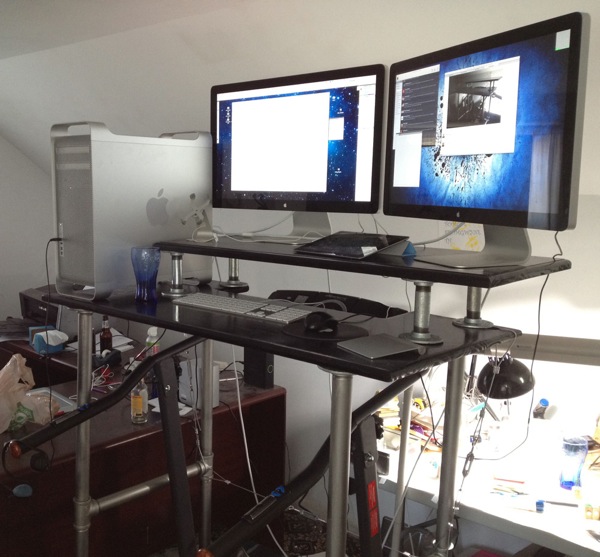
(Yes, there's a beer bottle in the background. That was my reward for finishing the desk.)
After I've been using it for longer and am convinced the design is good, I'll share how I made the desk for anyone who might wish to build one for themselves.
So far, so good, though. The desk seems to be solid, has no perceptible wobble, and the monitors and computer don't seem to be putting any noticeable strain on it. Yesterday, I walked nearly nine miles at an average of 1.6 mile per hour and had a productive work day. Today's about half over and I've burned a little over 600 calories while fixing two pretty gnarly bugs in client apps. These two days have been enough to convince me that this is going to work.
By having my good computer on the treadmill desk and my MacBook Air at my regular desk, there's a built-in incentive for me to walk, or at least stand, rather than sit at my desk. I'm simply more productive when I have more screen real estate and a more powerful computer.
In a week or so, I'll put together a parts list and basic instructions, but the design is pretty basic. 1¼" galvanized pipe makes up the main frame of the desk with ⅛" wire rope and turnbuckles as guy wires to provide additional lateral stability.
This is the treadmill I use:
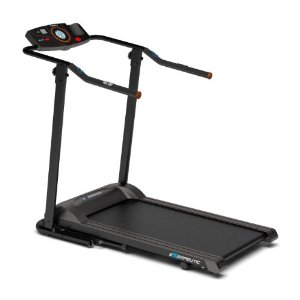
It's designed only for walking, will hold up to 400 pounds, and it's shorter than most treadmills, so it takes up less room. It's not cheap, but it's fairly reasonable for a treadmill at $400, and it can fold up out of the way if you need to. I've been very happy with it so far. While it's not whisper quiet, it's nowhere near as loud as most treadmills I've used, and it has a full set of controls on the handle where you can reach them easily while using it as part of a treadmill desk, which is much nicer than having to awkwardly reach over the desk to the treadmill's console.
The desk plans (when I post them them) are intended to work with this treadmill, you will probably need to make minor adjustments to use it with other models, as well as account for any height difference.
I've been steadily putting on weight and getting in worse shape since before the dot com boom. Since we started MartianCraft, I've had very few days off, and my average work day has been probably twelve hours, possibly longer. Every time I try and get into a routine of exercising, something happens: a client emergency, a deadline, a build, a new prospective client, a minor family emergency. When there's not enough hours in the day (and there never are), the exercise was always the first thing to get cut.
Recently, I came across this brilliantly simple idea from a Mayo Clinic cardiologist. It's called the Treadmill Desk. Essentially, you replace your chair with a treadmill, and instead of trying to get a good strenuous calorie-burning bout of exercise in a few times a week, you just walk while you're working. You don't walk fast; in fact, you go quite slow. They typically recommend that you walk between one and two miles per hour, which is about half of most people's normal walking speed. This speed allows you to function fairly normally. After just a few minutes, you can type and mouse normally. If it gets hard to type, you back off on the speed a little. It's not a race. It's not even exercise in the traditional sense.
I'm typing this blog post while walking on a treadmill.
The goal with this walking is not to break a sweat, but rather to just be in constant motion. You will want your office a touch cooler than normal, though, as even slow walking does raise your body temperature. Despite the low-key nature of the movement, a typical person burns an additional 100 - 130 calories per hour they're at their desk. For a typical person working an eight hour day, that's between 800 and 1040 calories per day. If you work longer hours or weigh more than the average person, it's even more calories. Now, think about that. You have to burn approximately 3500 calories to lose a pound of weight, so assuming you don't increase your caloric intake, that's about a pound every three to four days of work, or two pounds a week. For someone working a forty hour week, that's about five pounds a month, or sixty pounds a year without additional exercise or dieting. There's a lot of health benefits that go along with losing extra weight, also. Lower blood pressure, lower cholesterol, lower incidence of several types of cancer.
If you work more than forty hours a week, the benefits can be even greater, assuming you don't eat more to make up for the extra calories you burn.
I've talked to a number of people who are using treadmill desks, and the feedback was universally positive. Everybody lost weight – several of them a considerable amount – and all were in better health than when they started. And almost everyone said the following word-for-word phrase to me: "I would never go back to a normal desk".
After about the third person gave me the same basic story, I was sold. Sign me up! I can do this.
But there was a problem.
There are lots of plans for treadmill desks around the Internet and you can actually buy treadmill desks now. But, here's the thing: My primary machine is a Mac Pro with two 27" ACD monitors along with a crap-ton of accessories. I couldn't find any desk for under $5,000 that looked sturdy enough to safely and securely hold the weight of all my gear, and all the plans I found for building one seemed to assume the use of a laptop or small computer with small monitor.
Because of that big sheet of glass, Apple's monitors are heavy. Because of that big aluminum case, the Mac Pro is also very heavy. My computer and monitors alone weigh well over a hundred pounds, and I wasn't about to trust that much weight worth that much money to something that looked flimsy or was designed to hold a laptop.
I experimented for a week using a makeshift treadmill desk with my MacBook Air, and I found the walking and working quite easy to do, but also found myself constantly pining to move back to my desk to use my more powerful machine and bigger monitors. I usually abandoned the treadmill after about two hours when I'd start getting into more hardcore coding, not because of the treadmill, but because of the computer.
But, that week was enough to convince me that this was a good way to reverse the slow but persistent upward trend in my weight that's marked the last several years of my life. Unfortunately, it also convinced me that I could only make it work if I could find a way to use my computer while walking.
So, I decided to build my own desk. Building a sturdy desk this tall (over four feet tall in my case, since I'm 6'3" and will be standing on a treadmill desk that's about 6" high) turned out to be an interesting, but not-entirely-trivial engineering exercise. It took a couple of re-designs and a lot of swearing, but my desk is now done and I've been happily using it for a couple of days now.
Here's my rig on my desk (excuse the messy office):
After I've been using it for longer and am convinced the design is good, I'll share how I made the desk for anyone who might wish to build one for themselves.
So far, so good, though. The desk seems to be solid, has no perceptible wobble, and the monitors and computer don't seem to be putting any noticeable strain on it. Yesterday, I walked nearly nine miles at an average of 1.6 mile per hour and had a productive work day. Today's about half over and I've burned a little over 600 calories while fixing two pretty gnarly bugs in client apps. These two days have been enough to convince me that this is going to work.
By having my good computer on the treadmill desk and my MacBook Air at my regular desk, there's a built-in incentive for me to walk, or at least stand, rather than sit at my desk. I'm simply more productive when I have more screen real estate and a more powerful computer.
In a week or so, I'll put together a parts list and basic instructions, but the design is pretty basic. 1¼" galvanized pipe makes up the main frame of the desk with ⅛" wire rope and turnbuckles as guy wires to provide additional lateral stability.
This is the treadmill I use:
It's designed only for walking, will hold up to 400 pounds, and it's shorter than most treadmills, so it takes up less room. It's not cheap, but it's fairly reasonable for a treadmill at $400, and it can fold up out of the way if you need to. I've been very happy with it so far. While it's not whisper quiet, it's nowhere near as loud as most treadmills I've used, and it has a full set of controls on the handle where you can reach them easily while using it as part of a treadmill desk, which is much nicer than having to awkwardly reach over the desk to the treadmill's console.
The desk plans (when I post them them) are intended to work with this treadmill, you will probably need to make minor adjustments to use it with other models, as well as account for any height difference.
Wednesday, May 26, 2010
The Martian Invasion: Announcing MartianCraft
About four months ago, I joined together with my friend and co-author, Dave Mark and with Rob Rhyne, developer of the awesome Briefs prototyping tool, to form a new mobile software development company specializing in the iPhone and Android platforms. This software development firm is what I've somewhat cryptically been referring to "Super Secret Project A"¹, but its real name can now be revealed as: MartianCraft.
Our original plan had been to do a public announcement long before now, but something unusual (yet good) happened. Before we ever made our announcement, before we ran our first advertisement, before the ink was even dry on our incorporation papers, we got busy. Really, really busy. Our little covert, unannounced software development firm kept us too busy for the first few months to take on new clients. Even finding time to do all the various things that a new business needs to have done was quite a challenge.

Having now finished two relatively major projects and a number of smaller ones, we've now got a chance to catch our breath and get all our ducks in a row. We've even got business cards (well, they're coming soon, at least) and some T-shirts to wear at WWDC. We may even have a few extra of those to give out.
We also have something else: the bandwidth to take on a new client or two. If you're looking to have an iPhone, iPad, or Android application developed, or if you've got an existing application in need of a little help drop us a line! We're also available for onsite training, code and architecture reviews, weddings, bar mitzvahs, and bachelor parties! Well, maybe not the last few.
1 Super Secret Project B will be revealed shortly after WWDC, so stay tuned!
Our original plan had been to do a public announcement long before now, but something unusual (yet good) happened. Before we ever made our announcement, before we ran our first advertisement, before the ink was even dry on our incorporation papers, we got busy. Really, really busy. Our little covert, unannounced software development firm kept us too busy for the first few months to take on new clients. Even finding time to do all the various things that a new business needs to have done was quite a challenge.
Having now finished two relatively major projects and a number of smaller ones, we've now got a chance to catch our breath and get all our ducks in a row. We've even got business cards (well, they're coming soon, at least) and some T-shirts to wear at WWDC. We may even have a few extra of those to give out.
We also have something else: the bandwidth to take on a new client or two. If you're looking to have an iPhone, iPad, or Android application developed, or if you've got an existing application in need of a little help drop us a line! We're also available for onsite training, code and architecture reviews, weddings, bar mitzvahs, and bachelor parties! Well, maybe not the last few.
1 Super Secret Project B will be revealed shortly after WWDC, so stay tuned!
Subscribe to:
Posts (Atom)